


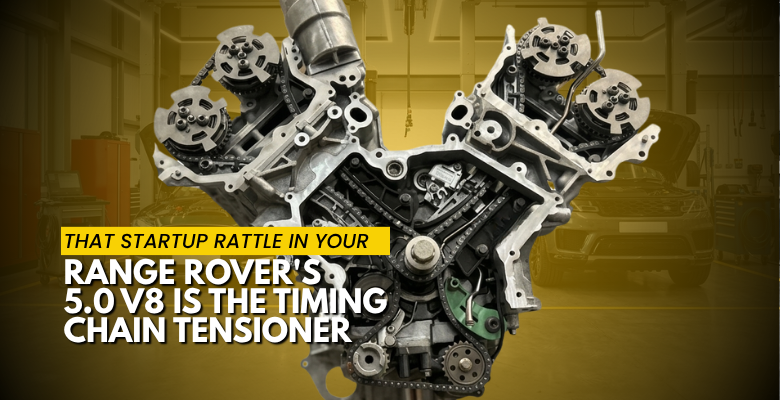
That Startup Rattle in Your Range Rover’s 5.0 V8 Is the Timing Chain Tensioner
by europewpadmin September 17, 2026Cool morning in Plano. You start your Range Rover Sport, or your F-Type, and something rattles hard for two seconds before it goes quiet. That isn’t the supercharger clearing its throat. On the Jaguar and Land Rover 5.0-liter V8, a cold-start rattle almost always means the timing chain tensioners have gone soft and the chains are slapping their guides before oil pressure catches up.
October mornings around Collin County make it louder, and more often. The gap between an annoying noise and bent valves is narrower than most owners believe, so a British V8 that rattles now needs a look now — not at the next oil service.
Quick Summary: Key Takeaways
- The noise is mechanical, not electronic: a two-second rattle at startup on the 5.0 V8 points at the secondary chain tensioners and guides.
- Cooler weather exposes it: thicker overnight oil drains back further, so the hydraulic tensioners take longer to pressurize and the chain slaps.
- Codes follow the noise: camshaft-to-crankshaft correlation faults show up once the chain has stretched enough to shift valve timing.
- Ignoring it risks the whole engine: a chain that jumps a tooth puts valves into pistons on an interference V8.
- Repair costs are climbing: every month you wait, the parts and labor bill for the same job goes up.
The 5.0-liter V8 has a known tensioner weakness
The AJ133 5.0 V8 — supercharged and naturally aspirated — uses a primary chain plus two secondary chains, each with its own hydraulic tensioner and plastic guides. Those tensioners and guides are the failure point, not the chains themselves.
You’ll find it in the Range Rover, Range Rover Sport, XF, XJ, XK and F-Type from roughly 2010 onward, and the early build years are the ones we see most. Heat cycling makes the plastic guide faces brittle while the tensioner loses its ability to hold pressure at rest, and the two problems feed each other.
Mileage matters more than age here. Past 60,000 miles, listen carefully.
A rattle that fades in seconds is the early warning
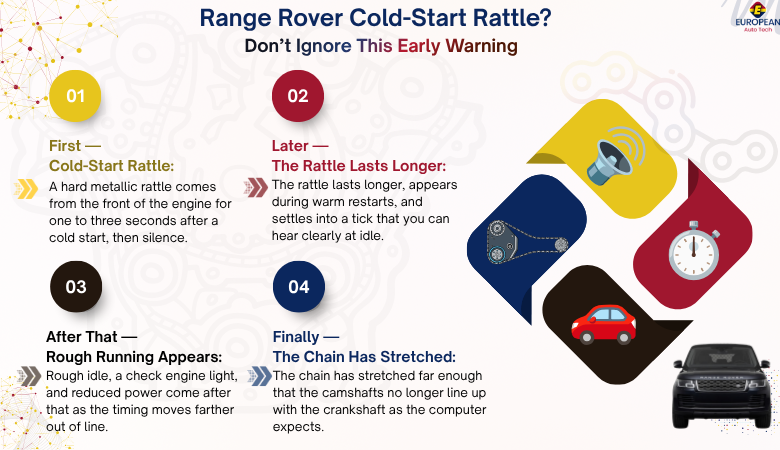
The first symptom is noise, and only noise. A hard metallic rattle from the front of the engine for one to three seconds after a cold start, then silence.
Later it changes character. The rattle lasts longer, shows up on warm restarts, and settles into a tick you can hear at idle. Rough idle, a check engine light and reduced power come after that, once the chain has stretched far enough that the camshafts no longer line up with the crankshaft the way the engine computer expects.
Late-autumn mornings make the problem louder
Cooler starts are harder on a tired tensioner. Oil that sat overnight at 45 degrees drains further out of the tensioner body and takes longer to build pressure on the first crank.
Plano owners who drive short hops — Legacy Drive to the office, a run up to Frisco, back home again — never build enough sustained heat to matter, so the engine lives in exactly the condition that punishes worn guides. The rattle you shrugged off in August gets your attention in October. That’s ambient temperature telling you the truth.
Waiting turns a timing job into an engine replacement
A chain that jumps one tooth on an interference engine bends valves. That is the whole risk, stated plainly, and it is why we treat 5.0 V8 rattle as urgent rather than as a nuisance.
Motor vehicle maintenance and repair prices rose 6.6% over the 12 months ending July 2026, according to the U.S. Bureau of Labor Statistics. Waiting doesn’t make the job cheaper — and if a brittle guide breaks up, you add debris in the sump, a scored chain path, and possibly a cylinder head to the bill. Fix the tensioners. Keep the engine.
How we confirm it before anything comes apart
We start with data, not with a teardown. A factory-level scan reads camshaft-to-crankshaft correlation values live, so we can see how far timing has drifted on each bank.
Then we listen on a genuinely cold engine — first start of the day, recorded — because a warm car in the bay tells you almost nothing. Oil condition and a look at the guide faces finish the picture. Only then do we quote. Guessing on a V8 this expensive isn’t diagnosis.
Plano drivers get the mechanical shop and the body shop in one place
European Auto Tech works on ten makes at 3953 N Central Expressway, with mechanical bays and a full collision center — body, bumper, paint, glass, dent and hail work — on one site.
For Jaguar and Land Rover owners that means one shop knows the car whether it needs a timing job or a repainted quarter panel. ASE Master technicians. A written warranty on parts and labor. We also serve Allen, Frisco, McKinney and Southlake.
Frequently Asked Questions
Q: What does a Land Rover 5.0 V8 timing chain rattle sound like?
A: A hard, metallic rattle from the front of the engine lasting one to three seconds after a cold start, then gone. Owners describe it as gravel in a can. If it lingers longer each week, the guides are wearing fast.
Q: How long do Jaguar 5.0 V8 timing chain tensioners last?
A: There’s no fixed interval — it’s a wear item driven by oil quality, heat and driving pattern. We see failures most often past 60,000 miles, and earlier on cars with stretched oil-change intervals.
Q: Can I keep driving a Range Rover with a timing chain rattle?
A: We advise against it. The 5.0 is an interference engine, so if the chain jumps a tooth the valves and pistons meet. A short drive to the shop is one thing; commuting on it gambles the engine.
Q: Will a bad timing chain set a check engine light?
A: Eventually. Camshaft correlation faults appear once timing drifts past the computer’s tolerance, but the rattle usually arrives months before the light does. Don’t wait for the dashboard to agree with your ears.
Book a 5.0 V8 timing inspection in Plano
If your Jaguar or Land Rover rattles on a cool morning, get it recorded and read before the first hard freeze. A tensioner job is planned work. A bent valve is not.
Hours: Sun–Fri 9:00 AM – 6:00 PM; Sat 9:00 AM – 4:00 PM
Website: europeansautotech.com