


Your Mercedes Is Shifting Hard on Central Expressway — Plano Heat May Be Cooking the Transmission
by europewpadmin July 25, 2026You’re crawling south on US-75 through Plano at 4 p.m., the dash reads 104, and your Mercedes starts shifting late and slamming into gear. That jolt is a warning. In triple-digit Texas heat, the automatic transmission runs hotter than almost anything else under the hood, and heat is what kills it.
Transmission fluid breaks down fast once it overheats, and a cooked 7G- or 9G-Tronic gearbox is a four-figure repair. Catch it early, and you pay for a fluid service. Wait too long and you’re pricing a rebuild. If your Mercedes felt off on the last hot commute here in Plano, have it looked at before August.
Quick Summary: Key Takeaways
- Watch the shifts, not the light: Late, hard, or slipping gear changes in the heat mean the transmission is already running too hot.
- Plano summers punish automatics: Stop-and-go traffic on Central Expressway plus 100-degree afternoons is the exact load that overheats the gearbox.
- Fluid is the first casualty: Overheated ATF loses its ability to protect the valve body, conductor plate, and torque converter.
- “Lifetime” fluid is a myth here: In this climate, a Mercedes transmission needs fresh fluid around every 40,000 miles.
- Early beats expensive: A $300 service now can save a $4,000 to $6,000 rebuild later.
Overheating Shows Up in How the Car Shifts, Long Before a Warning Light
The first sign is behavior, not a dashboard alert. Watch how it drives. Your Mercedes starts holding gears too long, then bangs into the next one, and on a hot day it may slip on the on-ramp or shudder at a steady 45 mph like the tires are running over rumble strips. That shudder is torque-converter lockup struggling in hot, tired fluid.
Timing is everything. If the car drives fine cold and acts up only after 20 minutes crawling through traffic on a 100-degree afternoon, heat is the trigger and nothing else. That’s your window. Fix it cheap now.

Plano’s Triple-Digit Days Push Mercedes Transmissions Past Their Design Limit
Heat, not mileage, is what finishes a transmission. A Mercedes automatic is happiest around 175 to 200 degrees of fluid temperature; sit in gridlock on US-75 or the President George Bush Turnpike on a 104-degree afternoon, and it climbs well past that. Every 20-degree jump above 200 roughly halves the life of the fluid, so a single brutal Plano summer can age a gearbox like years of easy driving.
Towing a trailer out toward Lake Lavon makes it worse. AAA expected to rescue 7.7 million drivers over the summer of 2025, and a heat-stressed drivetrain is a common reason a summer trip ends on the shoulder.
The Expensive Parts Fail Once the Fluid Cooks
When ATF overheats, it oxidizes, turns dark, and loses the film strength that protects moving parts. The conductor plate and valve body — the transmission’s electronic and hydraulic brain — start throwing shift faults. The torque converter clutch glazes. Clutch packs burn. Smell them, and it’s already too late.
The transmission cooler matters too. On most Mercedes, it lives inside the radiator, so a clogged radiator or weak cooling system lets both the engine and the gearbox run hot together. Fix one, check the other.
Skipping the “Lifetime” Fluid Is a Bad Bet in North Texas
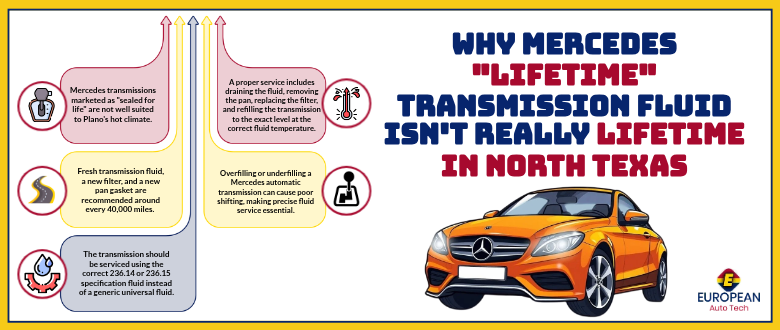
Mercedes markets some transmissions as sealed for life, and in a mild climate that’s almost defensible. In Plano it isn’t. We recommend fresh fluid and a new filter and pan gasket around every 40,000 miles, using the correct 236.14 or 236.15 spec fluid — not a generic universal jug that the counter guy swears fits everything.
A proper service is drain, drop the pan, replace the filter, and refill to the exact level at the right fluid temperature. Overfill or underfill a Mercedes automatic and it shifts just as badly as if it were low. Precision is the whole job.
How We Diagnose and Cool a Mercedes Transmission the Right Way
We start with a scan on factory-level equipment and an actual fluid-temperature reading, not a guess. That tells us whether you need a straightforward service or whether the valve body and conductor plate are already compromised. From there we service the transmission, flush and inspect the cooling system, and road-test in real Plano traffic.
Straight answers, no upsell. Owners across Plano, Frisco, Allen, and McKinney bring us the German cars other shops shrug at, precisely because we tell them the truth about what a repair needs and what it doesn’t. Come in before the next heat wave. We’ll tell you exactly where it stands.
Frequently Asked Questions
Q: Why does my Mercedes shift hard when it’s hot outside?
A: Hot weather raises the transmission’s fluid temperature, and overheated fluid can’t build proper hydraulic pressure or protect the clutches. That’s why the shifts turn late, harsh, or slippery after 20 minutes in summer traffic but feel fine when the car is cold. A fluid-temperature scan confirms it.
Q: How often should a Mercedes transmission be serviced in Texas?
A: Despite the “lifetime fluid” label, in North Texas heat we recommend a full fluid, filter, and pan-gasket service around every 40,000 miles. The climate breaks fluid down faster than Mercedes’ mild-weather assumptions, so a shorter interval is cheap insurance against a rebuild.
Q: Is it safe to keep driving a Mercedes with a slipping transmission?
A: No. Slipping means the clutches are already wearing, and every hot mile adds heat and metal to the fluid. Keep driving, and a repairable problem becomes a full rebuild. Get it scanned right away and stop driving it hard until you know what’s wrong.
Q: How much does a Mercedes transmission repair cost?
A: A fluid, filter, and gasket service is a few hundred dollars. A conductor plate or valve body runs more. If overheating has already burned the clutches, a rebuild or replacement can reach $4,000 to $6,000 — which is exactly why catching it early pays off.
Have Your Mercedes Checked Before the Next Heat Wave
Noticed hard shifts or a shudder in traffic? Bring your Mercedes in while it’s still a service and not a rebuild.
European Auto Tech — 3953 N Central Expy, Plano, TX 75023
Hours: Open Sunday-Friday 9:00 AM – 6:00 PM, Saturday 9:00 AM – 4:00 PM
Website: europeansautotech.com