


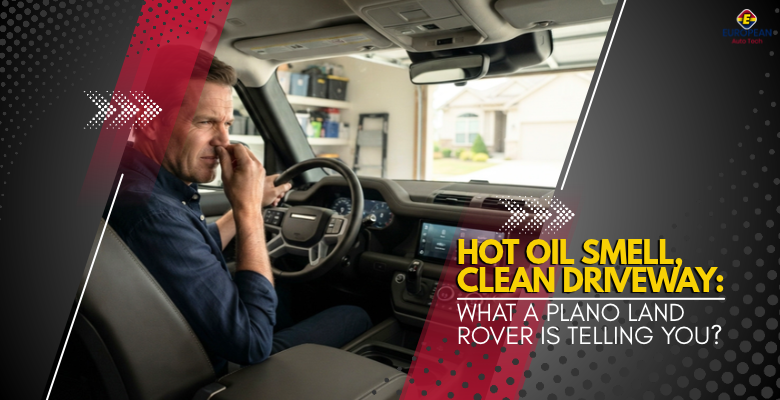
Hot Oil Smell, Clean Driveway: What a Plano Land Rover Is Telling You
by europewpadmin November 23, 2026You notice it at a long light, then again in the garage after you park. The smell of hot oil arrives through the vents, not from any spot you can point at. You get out, crouch down, and find clean concrete. So the car cannot be leaking, and you go back to driving it.
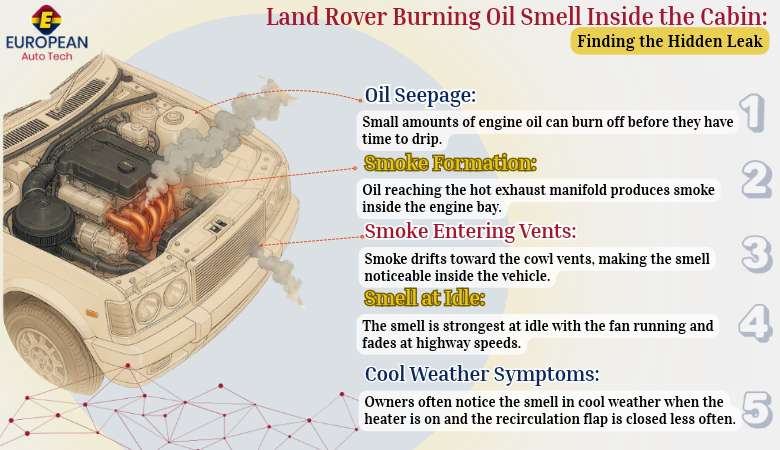
The car is leaking. The oil is simply never reaching the ground. A Land Rover or Jaguar V8 carries its exhaust manifolds up high and close to the heads, so anything weeping from a seam above them lands on metal hot enough to burn it off on contact. You get the smell without the evidence, and the two are the same event.
The smell is the leak, reported by a different route
A seep that burns off is still a seep. Engine oil smokes at a temperature an exhaust manifold passes within a minute of a cold start, so a few drops an hour never survive long enough to fall. What you get instead is smoke inside the engine bay that drifts to the cowl vents, and that is why the smell is strongest at idle with the fan running and fades once you are moving at highway speed.
That also explains the timing. Owners usually notice it in cool weather, when the heater is on and the recirculation flap is closed less often, and they assume the cold caused the leak. The cold only changed how you breathe the air around the engine.
On these engines, the leak paths sit directly above the exhaust
The supercharged and naturally aspirated V8s used across Range Rover, Sport, Discovery and the Jaguar line put several oil joints in the worst possible place. Valve cover gaskets run along the top outer edge of each head. The timing cover seam comes down the front. Cam carrier and plug tube seals sit higher still. All of them drain downhill onto manifolds, turbocharger housings where fitted, and the heat shields bolted around them.
Oil that lands on a heat shield does not evaporate cleanly. It cooks into a varnish, builds up over months, and smokes harder each time the engine gets hot. The smell grows while the oil consumption stays exactly where it was.
Smoke under the hood is a fire question
Most of these cars never catch fire, and we are not interested in scaring anybody into a repair. The numbers still argue for dealing with it now, not at the end of a long holiday drive. National Fire Protection Association figures carried on the U.S. Fire Administration’s statistics pages put 2024 at 211,500 vehicle fires, 18.5 percent of them traced to a failure of equipment or a heat source. Oil on a glowing manifold belongs in that category, and the risk climbs with how long the deposit has been building.
There is a second, duller cost. Oil-soaked rubber swells and tears, so hoses, grommets and wiring looms near a weeping joint tend to need replacing alongside the gasket if the leak has been running for a year or two.
Plano traffic is what turns a seep into a smell
A cold engine barely does this. Underhood temperatures need time to climb, and the climb takes traffic. Sitting on Central Expressway between Parker and Plano Parkway, or crawling through the Legacy area at the end of the day, is exactly the condition that soaks heat into the manifolds with no airflow to carry it away. North Texas winters do not change that much, because the engine makes its own weather once the thermostat closes.
So the smell often appears in the commute and disappears on a weekend run out to McKinney. It is the same leak either way, reported differently because the air moving through the engine bay changed.
What actually gets done about it
The job starts with finding which joint is wet, and that means cleaning the engine properly first, then driving it and looking again. Guessing from the smell alone usually gets the valve covers replaced on a car whose real leak was the timing cover, and the owner pays twice.
Once the source is confirmed, the repair is a gasket or a seal, plus the unglamorous part: scrubbing the baked deposit off the manifolds and shields so the smell actually stops. Skip that step and the car still smokes for weeks afterward, and nobody believes the repair worked.
While the covers are off is also the sensible moment to put fresh oil in, since what remains in the pan has spent the last stretch of its life circulating past a leak.
Frequently Asked Questions
Q: Why does my Land Rover smell like oil but never leave a spot?
A: Because the oil is landing on hot exhaust parts and burning off before it can reach the ground. A clean driveway only rules out a heavy leak.
Q: Is it safe to keep driving with a burning oil smell?
A: For short trips, usually. The deposit builds up over time though, and oil-soaked wiring and hoses are a separate problem worth avoiding. Have it looked at before there is smoke you can see.
Q: How do you tell which gasket is leaking?
A: The engine gets degreased, then driven, then inspected again, sometimes with dye in the oil. Clean metal shows exactly where fresh oil appears.
Book It In and We Will Show You the Wet Joint
If your Range Rover, Discovery or Jaguar has started smelling like a hot engine, the first visit is a lift, a degrease and a careful look. You see the joint that is actually wet before anything gets quoted.
European Auto Tech — 3953 N Central Expy, Plano, TX 75023